
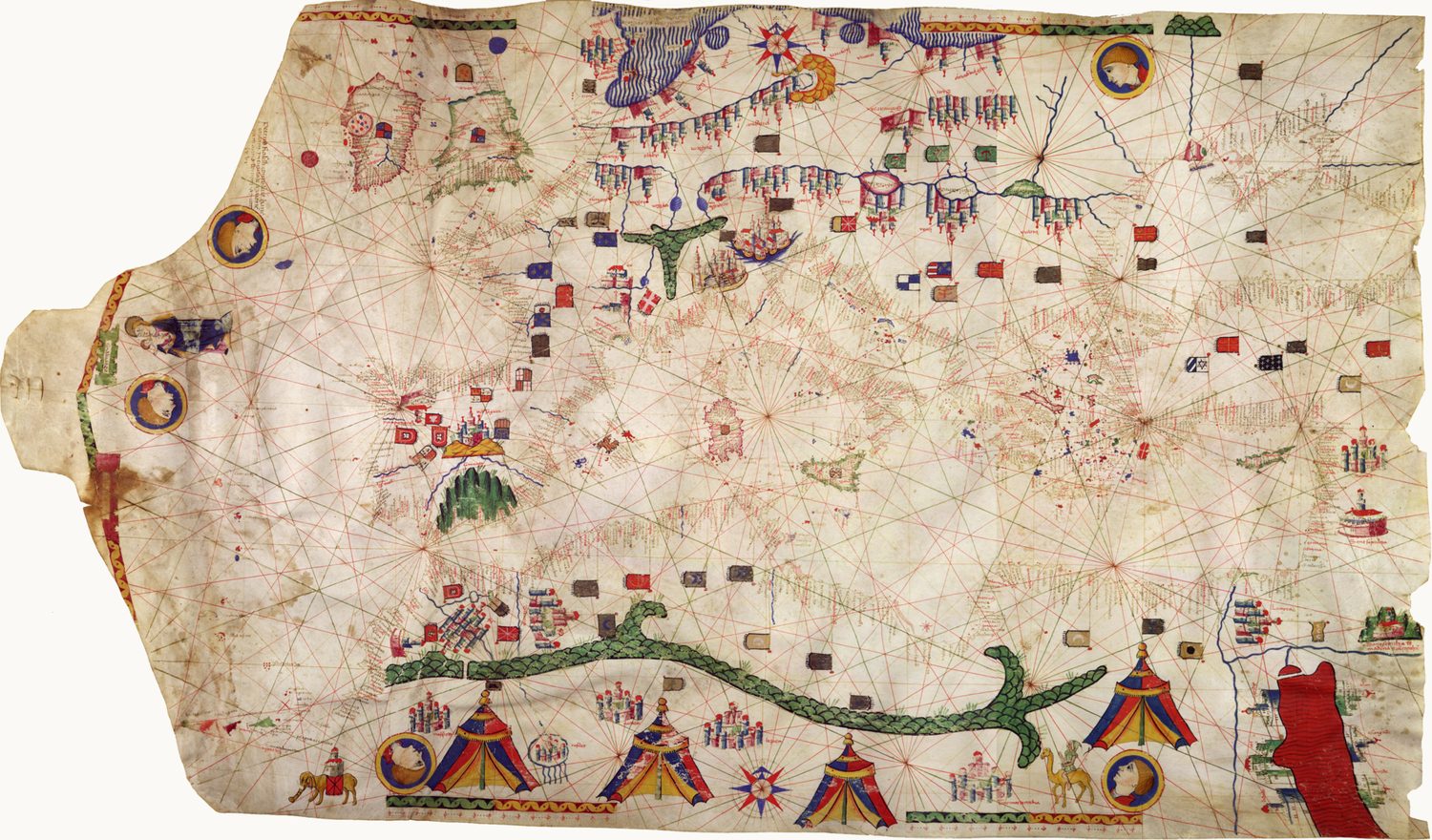
Before I tell you anything else, imagine owning three different maps of the same world and not one of them marking where you are. Instead, only where you have been, and where you cannot quite reach.
Actually, imagine three different cartographies of the same world, drawn by three different peoples who would use it for various purposes. In each map, different rivers are named, different silences are folded around, and different coastlines are deliberately left blank. They do not agree on where the grief goes, or whether it is a place to be, or a road to cross; even what the longing would be called, or whether it belongs in the legend at all. Now imagine laying them on top of each other. What you would get is not a more complete version of the world, but a palimpsest rather: an argumentative mess of overlapping lines, the same ocean under many aliases, and some of many islands appearing on only one map, unnamed on all the others. Perhaps some cartographers never thought to name those pieces of land, never needed to because they never reached them. A map, after all, is just a language. It displays where the border ends and what counts as open water. Every map is an argument full of what people noticed, what they could not afford to leave unnamed, unexpressed. Every word is then evidence: proof that someone, sometime, required a container for one exact feeling, may it be the quality of foreignness or the species of grief. This vessel, constructed from sound and breath, can be the only home a feeling ever gets.
I speak Turkish, French, and English; in that order of acquisition, in roughly the reverse order of daily use. I grew up trusting languages; thinking in French, I would find my way at school; Turkish would guide me through emotional expression; English would outline the shortcuts to unpathed worlds. I have been lost far too many times.
Three languages means three maps. Sometimes they overlap; coastlines blend seamlessly into one another that one cannot distinguish one from the other; they become a single, unified place. Often they do not, however. Standing where all three edges converge, I am, technically, in the middle of the sea. This is an attempt to navigate. It is also, inevitably, written in English, which means some of it is already lost in locution. But we will get to that.
Turkish was not the language I chose so much as the family I was born inside. It had arrived before I had opinions about language; it taught me how to perceive, interpret, and articulate. Hence, it went deep, as firsts are wont to do, leaving a lexicon in me that no other language has the precise coordinates for. Hüzün is one word I have long struggled to convey to non-Turkish speakers. Not because they ask, they rarely ask, but because without that word, I am constantly trying to lead them to a place that does not exist on their map. The closest English gets is melancholy. Then it wears a beret and becomes mélancolie, which does not get any closer. Hüzün is not personal or internal, but rather collective, external, and sensed. It has a history of which it carries the weight, dragging you down even when your wings are ready to fly. It feels as rude as the abyssal waters that catch the colour of bright sunlight.
What hüzün shares with vide, the French word for the particular hollow a thing leaves when removed, is that both are predicated on absence. Vide does not mean empty; it is the shape of what was once there, therefore its absence is noticed. It is an outline pressed into the air, a trace that the mind cannot ignore. Void in English, being a faint relative, derives from the same root but is less loaded with emotion. Void is cosmic. Void is dramatic. Vide is quieter and domestic. And probably because of this, tougher to dismiss.
Attempting to translate these words would have the same result as carrying water across a room in your bare hands. The gesture is what it all remains by the time you arrive, and the floor is wet, wet in the pattern of your hurry. In the end you stand there holding nothing, which oddly enough is the concept you strived to explain in the first place. What I am describing, besides the objective correlative of all of this, is a feeling of exile. Though, this exile has nothing to do with borders or passports; it is the pervasive exile of living at the edge of your own expression, being fully aware that what you mean or what you are able to voice are not quite the same in any language, and that the gap between them is where your expression actually exists. Turkish has gurbet for this: the condition of being far from where you knew as home, the texture of distance, the burden of not belonging. I once read the map without squinting. Now my coastlines drift imperceptibly, incrementally, until one day I look up and the shore is not where I left it. Words stiffen into unrecognisable morphemes; familiar syntaxes reroute themselves. The map still works, technically; but I am in the gurbet of my own language. The French have a concept called l’esprit de l’éscalier. Architecture, after all, is just another way to map a space.
Literally: the spirit of the staircase. The perfect sentence you should have crafted, the precise, even so annihilating observation, everything in the right order arriving in your mind, just as you are leaving, already too late, while descending.
Would it be more understandable if I explained it like this?
Every language has the experience, but only the French built a staircase out of it. Feelings and thoughts are shared across many people of many languages. However, one particular language happens to notice them first, and has the architectural sense to preserve them. The untranslatability of words does not render the experience exclusive to their coiners. Instead, the words become the addresses of what they represent, for them to be found whenever required, wherever is appropriate.
The three maps of my life are full of such addresses. Dépaysement, for instance, when the French are being startlingly precise, is used to describe the sentiment of being in a foreign land, unmoored in a gentle way, yet curiously refreshed. It is not homesick, which would imply a tenuous desire to go back; and especially not lost, as there is no destination being reached. It is something more subtle: the self grows gradually translucent in the absence of the usual context, in an environment where the past self cannot track one down, the street signs are in a different alphabet, and one’s habits are prone to change. And in this accumulation of absences, you discover how much smaller and stranger you are compared to your ex-vision of yourself, and this is – siktir!1 (I still swear in Turkish upon epiphanies, and I assume I always will) – actually interesting. Dépaysement lives on the French map and nowhere else. It is one of those islands the other cartographers never charted. And yet, I have felt dépaysement my whole life, not necessarily in strange places, but within and between languages. While reaching for a word in Turkish and arriving in English, beginning a sentence in one cartography and completing it in another, I unwillingly became an outsider to my own self-expression.Here is the part I have been approaching in circles.
A specific kind of loneliness lies in the space between languages; not the loneliness of not being able to find someone to speak to, but the loneliness of knowing that a clear and concise equivalent of your state of mind exists in a language your listener does not speak. No matter how much time you are given to explain, carrying hüzün among those who are only familiar with melancholy is to carry an unshareable weight. Nevertheless, you try. You describe it, you gesture at it, you say it is the hazy sense of loss that does not begin with you, nor will it end with you. Then they nod. You both know the nodding is solely in the shape of your effort. The same words, reminiscent of solid and reliable landmarks, the kind you navigate by, emerge as, on the wrong map, abyssals. The richness and the isolation of three maps are not separate conditions experienced at diverse times. They are lived through simultaneously, the ratio between them shifting depending on which map is considered the mainstay of the conversation, whether it be internal or external.
I want to be careful here, because there is a version of this that becomes too satisfied with its own difficulty; too eager to transform a genuine loneliness into something decorative and wearable, too quick to arrange the pain into a pattern and call the pattern beautiful. The untranslatability is often just loss: the loss of underexpressed emotions, underemphasised meaning, and delicately traced nuances. Gurbet is not romantic, nor is vide intriguing.
And yet.
And yet there is yakamoz: a three-syllable Turkish word for the reflection of moonlight on water. Neither the moon, which is ay in Turkish, nor the water, which is su, is represented in the structure. The word is specific to the reflection, to the third thing where the light is not quite light but the image that exists solely in the relationship between a source and a surface. It is the denouement of the two collapsing, the origin and the ground, unfolding into a realm even more ethereal. Yakamoz is what I think language does at its best: in both English and French you need a sentence; in Turkish you need seven letters and then, mercifully, the night does the rest. Not the grief itself, but hüzün: the grief as it refracts through centuries, and the people who unwittingly inherit its echo. Not the void, but vide: the emptiness in the precise shape of what used to fill it. Not homesickness, not foreignness, but dépaysement: the feeling of the self discovering the joy of nascent possibilities. These words are all yakamoz, by their own means: reflections of perceptions too large or too liquid to be communicated in any other way. They do not claim to be the thing. They claim only to be its light on water, its trace on the map.
And this, I suppose, is where trust begins.
The language I trust the most is the one that emerged from the mixture of all three, in which I think privately, that has no name, no syntax, or grammar. It probably could not be transcribed, only wandered, as it has never been asked to perform for anyone. But in the act of writing – of choosing hüzün over melancholy, gurbet over abroad, and yakamoz over any English sentence I could construct – I perform the act of trust in the opposite direction: trust extended outward, toward the reader, toward the language itself. To use an untranslatable word in a sentence and not feel the immediate urge to explain it, not defusing it with similitude, is presuming that the emotion it holds will travel the distance anyway. Sometimes the bet fails, as all bets do. Sometimes it is just an appreciated nod. But the willingness to make the bet, to release the vessel and trust the water, is, I have come to believe, the nearest form of fluency that can truly be reached.
Au-delà. Beyond. In French, it also stands for the horizon: that thin, luminous line where the sky meets the sea, which resembles the end of the shore, but recedes as you approach it, and has always receded, and will always recede. It was once believed by sailors to be the edge of the world, the threshold of the unknown. For me, the horizon is the original untranslatable word. Although it is visible to everyone, it does not belong to anyone’s map.
It is always, precisely and without exception, au-delà: beyond the place where you are, even beyond the place where you are aiming to reach,
always the same distance from the bow of the ship, and always radiant, and always, essentially, unreachable.
For a long time, I attempted swimming towards it; I thought the task was to touch it. More languages, more coastlines, more islands for more words, until I accumulated enough maps to cover the abyss entirely and arrive somewhere solid and complete and fully articulate. I was mistaken about this, just as the sailors once were, because fluency is not the horizon, for the horizon itself is not a destination. The horizon does not resolve; it does not reward approach by coming closer. It is not a shore, nor the shore, but the measure of how vast the unnamed is.
And so, I have let go of trying to arrive. I have started, instead, to swim and to sail, which is by no means surrender. On the days when hüzün will not cross and vide will not fill and the person in front of me nods at the more-or-less thing with great and well-meaning sincerity, I remind myself that to swim is to stop fighting the water and begin to exist with and in it. To understand water is to place yakamoz in a paragraph and let it sit, three syllables pointing at something the surrounding words cannot touch; to write vide and trust that the person reading feels the outline of something removed without needing the etymology explained; to write au-delà and mean the horizon, and mean the feeling of always reaching, and mean the way three maps make a life that is excessive and difficult, but, ultimately, boundless. No single, complete cartography can account for all the islands, yet the willingness to keep reaching, making the bet and trusting the crossing, is believing that yakamoz will do what no sentence could, finally marking those islands that were once overlooked on the other maps. To write au-delà is to trust that the reaching is its own kind of arrival.
I carry three maps to a place that none of them could ever give. I speak in three languages, yet in none of them do I authentically live.